
Doctors’ Blame & Shame – Ontario Bill 29

Steve ClarkThe Toronto Star loves Steve Clark.  The Conservative MPP sings from the Star’s hymn book with his Bill 29 – An Act to Amend the Medicine Act, 1991.

Clark crusades on total transparency. He calls for full reporting of all complaints against physicians, all deaths reported while under their care; including complaints and deaths from other jurisdictions.

Transparency – what could be more wholesome?

The public deserves to know about every single death.  It’s condescending to think the public needs protection from the facts. The public needs protection from nefarious physicians. If there’s any chance the information might help one patient, the information should be public. Right?

Blame and Shame for Death

Who gets attributed with a patient’s death?

When a patient dies of cancer, does the family doc who knew the patient for years get labelled? How about the surgeon who operated 2 weeks before?  Maybe the intensivist?  The palliative care doc?

Or should it be the naturopathic doc who attended to the cancer for 18 months before the patient sought medical attention?

Physicians who practice palliative care will have a high number of patient deaths.  Does that make them bad doctors?  Even if a palliative care doc is a murderous physician, how would the public know based on the reports?

Would Bill 29 encourage physicians to care for the very sick, those in greatest need? Most attempts to rescue the dying rest on slim hope. Shall we reward these deaths with blame and shame?

Blame and Shame for Complaints

Many patients write complaints, not just thoughtful people from the Toronto Star.  Often, patients with major mental health challenges have the most time to craft complaints.  Aside from the obvious ones, many complaints require investigation to reveal that psychosis, delusion, or other cognitive challenges determined the content.

Many complaints focus on things out of MD control: wait-times, legislated reporting to the Ministry of Transportation (patients hate this!), no beds available in the emergency department…

Blame and Shame – Help or Harm?

The most important question is How will this impact patients?  Will Bill 29 improve quality and safety?

The Patient Safety and Quality Improvement group from Duke says,

“This ‘shame and blame’ approach leads to hiding rather than reporting of errors, and thus is the antithesis of a culture of safety. Recent efforts have tried to change this—to encourage people to report problems rather than hide them, so they can be addressed.”

The World Health Organization writing on safety cultures notes that blame and shame does not work.  It does not improve safety.  The Canadian Patient Safety Institute says the same thing.

Here’s one of dozens of academic articles suggesting better alternatives to blame and shame – Relationship between safety climate and safety performance in hospitals.

Healthcare wrestles with creating safe places for providers to talk about ways to improve care by sharing their concerns without fear or shame. Bill 29 takes us back decades.

What’s been your experience? Does a culture of blame and shame improve performance anywhere?

 photo credit: steveclarkmpp.com
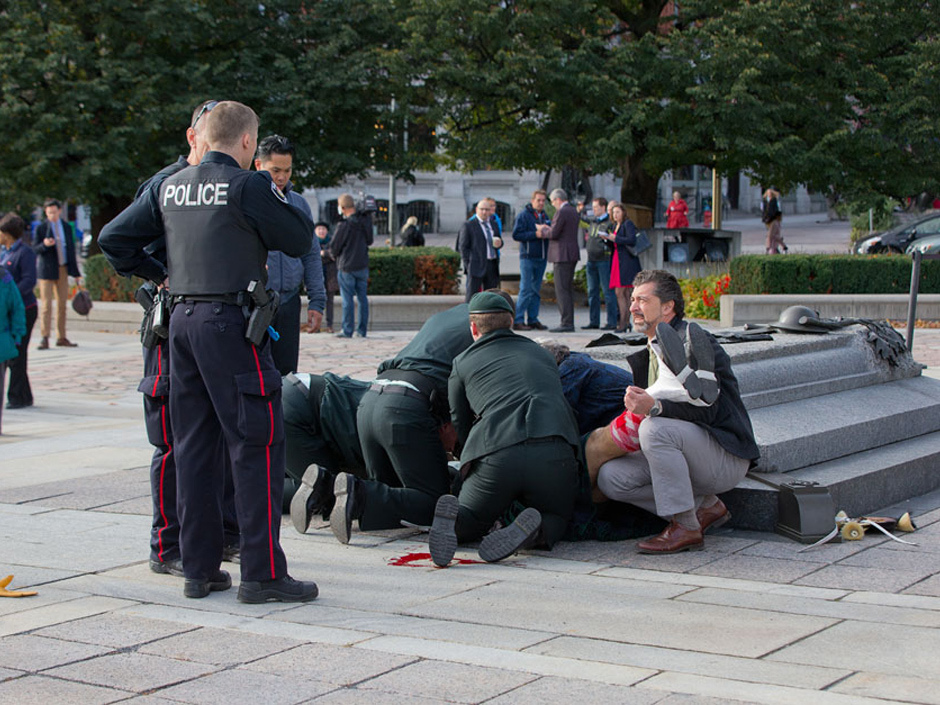
Terrorism, Canada, Crisis

1023 Shooting 284.JPGOur minds spin. Our world marred.

Watching terrorism in Canada, we take comfort knowing security forces live for this.  They exist to manage emergencies.  We expect they will be there when we need them.

We watch armoured vehicles mobilize on Parliament hill.  A medic performs CPR on an honour guard. Police in black facemasks and ballistic vests point revolvers at rooftops as politicians dive into tank-like trucks.

We need Canadians in uniform.  We honour their commitment and sacrifice. As civilians we never understand the toughness required to run into danger to protect our freedom, our way of life. If asked, we would do almost anything to support them.

Canadians inherit pioneering toughness. New Canadians know courage, risk and resourcefulness coming to a new country, a new life. Third and fourth generation Canadians know grit when death and financial ruin were realities of climate and landscape. Perhaps some heritage Canadians have never known vital challenge – never needed self-sufficiency – but they are few.  Canadians know how to manage.

Crisis reveals the limits of our system, and it gives government reason to take more control.

Living in the North requires confidence to take personal control in crisis.  A nanny state that turns Canadians into undeserving recipients of state beneficence insults the fabric of Canadian identity.  It undermines the core nature required to thrive in the North. But in national crisis, we risk compromise of identity for state solutions.

Terror on Parliament Hill. Ebola threatening. Acute care overwhelmed.

Canada will emerge stronger from all of this. Thank God for soldiers who sacrifice for us, for our way of life. Let’s hope our leaders avert crisis without crushing our freedom, our passion, and our Canadianism in the process.

photo credit: nationalpost.com

Healthcare Ideology – Premier Stirs Debate

Premier Brad Wall SaskatchewanTommy Douglas, father of Medicare, would have spit out his coffee.  The Saskatchewan Premier said,

“When it comes to a choice between prompt diagnostics, prompt surgery … and ideology, the people of this province will choose the diagnostics and the surgery.”

What irony coming from the province that started rationed medical services.

Here’s part of what Brad Wall said on  NewsTalk650, radio call-in:

UPDATE: Premier considers private MRI clinics to decrease wait times

Reported by News Talk Radio staff

Premier Brad Wall is floating the idea of allowing access to private MRI clinics in Saskatchewan to reduce wait times for diagnostic procedures.

On John Gormley Live Thursday, Wall said it’s something that deserves “serious consideration.”

“I will not rule it out. When it comes to a choice between prompt diagnostics, prompt surgery … and ideology, the people of this province will choose the diagnostics and the surgery,” Wall said.

Wall was responding to a question from a caller on the show who said the three-month wait list for an MRI scan through the public system, could have been avoided had he been allowed to pay for the procedure at a private clinic in Regina.

“We allow more private operators on the surgery side. That’s why we’ve seen wait times come down for surgeries … can it work on the diagnostic side? These are the questions we’re asking now and I think this is something that deserves consideration,” Wall said.

The government currently utilizes the private sector for some surgeries, but Wall said the province has built in a barrier that prevents private providers from robbing front line staff from the public system.

“If we can do that with diagnostics, with MRIs does it make sense that the wait list is going to shrink because those who want to pay will come off that public wait list. And thereby shortening the wait list for all, whether they wish to pay or not.”

The NDP responded with, “We want the government to build the capacity in a public system so that all people, regardless of how much money you make, gets the care necessary in a timely fashion.”  The NDP did not comment on people travelling out of country to purchase care right now. How equitable is that? (See more media coverage from CBC.)

Healthcare Ideology

Napoleon first criticized his opponents as ideologues: those who hold rigid, inflexible opinions resisting change.  (Merriam-Webster for more definitions)

You might be a healthcare ideologue if:

  • You defend the status quo as long as “all people” get the same service regardless of quality
  • You berate patients for accessing care (“Those patients should have treated their minor illness at home!”)
  • You support sending patients away from emergency and clinics if a nurse deems the symptoms trivial
  • You criticize patients as system abusers when worry drives them to seek reassurance
  • You believe it’s okay to mislead voters with sound bites so long as it increases support for ideology
  • You disparage physicians who question the status quo
  • You march, chant and fight to protect a system that makes you fat while letting patients languish on wait lists

Without ideology, our system might change and look like the – Gasp! – German, Swedish, British, or any other patient focused system.

Positive Ideology?

Is there nothing worth fighting for?

Of course: patients; access to care that meets their concerns; safe, timely care that provides an outstanding patient experience.  But this is vague; tough to make into ideology.  It requires patient input and opinion, innovation and creativity. It demands change to improve things for patients, not just more money to patch an over-capacity lifeboat.

Ideology grows much easier from rigid legislation and crisp social planning.

Safety in High Risk Environments

A parachute that fails only a few people is worthless.  Medicare cannot just be great most of the time. It must excel at meeting patient’s greatest needs 100%.  It needs a back up, maybe many levels of back-up.  Medicare needs safety systems that guarantee patients never wait beyond what’s safe, never need to endure an intolerable care experience.

Are you a healthcare ideologue? Are you focused on patients or legislation?

photocredit: newstalk650.com