
Are We All Socialist When It Comes to Medicare?

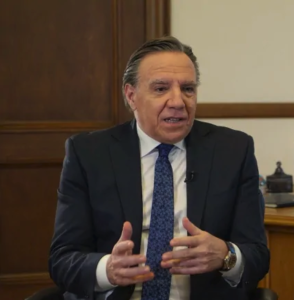
Legault
Does any government value freedom anymore?

Politicians have chased the medicare merry-go-round for decades. Each party pours on money or passes new legislation.

In 2004, Prime Minster Paul Martin’s Liberal government aimed to fix wait times. So it threw $41.3 billion dollars into a Health Accord.

The Harper Conservatives kept Martin’s Accord. But Harper slowed increases in transfer payments to 3%, after the Accord ran out.

While in opposition, Justin Trudeau railed against Harper’s handling of medicare. But after the election, PM Trudeau’s Liberals decided that Harper’s 3% was wise after all.

For all the bluster, political parties act the same. They either maintain the speed of the merry-go-round, or they give it a push and make it spin faster.

Private Practice, Public Payment

Canadians love free health care and hate the idea of bureaucrats controlling the care we receive. Canadians believe that doctors should provide whatever care we need (private delivery), and the government should pay for it (public payment).

Medicare calls it public payment and private delivery. Patients get free care, and doctors get to provide care based on science, not politics. Doctors and hospitals are privately owned businesses.

Dr. C. David Naylor, historian and health expert, captured the relationship in his book, “Private Practice, Public Payment” (1986). The message was clear: Canada is not socialist. We simply have state insurance, with private delivery, of medically necessary care. The government promises to pay and not meddle.

The trouble is that no one sees it that way anymore. All political parties believe that if the public pays, then it should drive. Government pays, so government should be in control. Continue reading “Are We All Socialist When It Comes to Medicare?”

Inequity Aversion, Relativity, and Envy

Try this at home. You need two pets of the same species.

Give one of them a tasty treat.

Give the other regular food.

What happens?

Dr. Frans de Waal did this with Capuchin monkeys. His 2 minute video went viral.

Inequity activists love to show it at conferences:

Animal Extrapolation

Apparently, monkeys love fairness: Capuchin’s possess “inequity aversion.”

Monkeys value equal pay for equal work. Furthermore, monkeys teach us that it is normal for mammals to express outrage at inequity. Throwing things and rattling cages are the direct result of inequity. The animal kingdom proves it.

I assume de Waal’s comment about Occupy Wall Street, at the end of the video, was a joke.

Anyone who knows animals knows that animals do not value equity. Monkeys do not have an aversion to inequity any more than they have an aversion to pay gaps, glass ceilings, or the top 1%.

Monkeys cannot identify inequity. Humans identify inequity. Animals see something they want and then they try to get it.

Attributing human characteristics to animals is called anthropomorphism. It is irresistible and wrong. Disney made a fortune with it. Continue reading “Inequity Aversion, Relativity, and Envy”

Socialized Medicine: What’s in a name?

Socialized Medicine making a come-back.

Last fall, Jim Carey, the well-known comedian, spoke on Real Time with Bill Maher about Canadian single payer medical care:

“I grew up in Canada, OK? We have socialized medicine.

I’m here to tell you this bulls**t line you get on all the political shows from people is that it’s a failure. ‘The system is a failure in Canada.’

It is not a failure in Canada.”

Carey used an old term for the mascot of Canadian exceptionalism. Twenty years ago, socialism was dead. People avoided calling anything socialized, especially Canada’s crown jewel of post-war welfarism.

Even today, people still prefer to talk about single-payer healthcare. It ranks between 5- and 25-times more common than socialized medicine on Google trends since 2004.

Celebrities love to defend socialized medicine. That should not surprise us. But their comfort with the term ‘socialized’ is worth noting. As the New Yorker published this spring, socialism is back.

A Glorious Beginning

Socialized medicine started in the late 1960s with a promise: care regardless of ability to pay. Doctors and nurses could keep doing what they had always done. And government would pay. Who could argue with that?

The glory days of socialized medicine ended soon. Continue reading “Socialized Medicine: What’s in a name?”