

Going Nowhere Fast — Who’s the MRP for health care?

Everyone wants better health care in Canada. But no one knows who should fix it. Who’s the most responsible politician (MRP)?

The provinces are in charge, according to the constitution.

But the federal government is in charge based on the Canada Health Act (CHA) plus billions in Canada Health Transfer payments (CHT).

It’s like two people in a rowboat, one on each oar, both trying to row in different directions. It’s fun to watch, but painful to ride.

I wrote “The Most Responsible Politician: Who’s the MRP for Health Care in Canada”, with the Macdonald-Laurier Institute this summer.
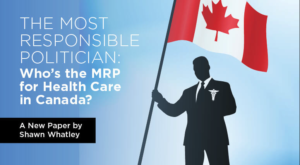
Here’s the press release summary.

For a 2-minute version, check out the blog below.

Who’s MRP for Health Care?

The MRP concept is old. Most Responsible Physician (MRP) now includes Practitioner, with NPs as MRP in some cases.

When dozens of people run from all across the hospital to help a patient who is turning blue, one person needs to be in charge of the Code Blue.

Every major trauma needs a Trauma Team Leader. Someone needs to lead and take responsibility for team decisions.

Admitted patients come to harm if they do not have a clear and explicit MRP.

Canadian healthcare has no clear MRP.

Provinces run daily operations. Their authority comes from the British North America Act (1867). But the feds have ‘spending power’, which is the power to make payments “for purposes on which it (Parliament) does not necessarily have the power to legislate” (PE Trudeau).

In other words, the feds use money to get power. Instead of seeking a constitutional amendment, they can give grants with strings attached, called conditional funding. Continue reading “Going Nowhere Fast — Who’s the MRP for health care?”


Medicine Before Medicare from Doctors Who Lived It

Victors write history, and medicare is no different.

The vast majority of doctors opposed socialized medicine. As a group, they have been vilified for it ever since.

No one writes books praising doctors in Canada.

Every Canadian schoolboy knows that only the rich got care before 1970. Poor Tommy Douglas almost lost his leg, had it not been for a charitable surgeon.

Medicare saved Canadians from amputations and atrocity. But doctors have been trying to sabotage it with useless services since day one. Andrew Coyne just wrote in March,

When doctors are paid fee-for-service, they have an incentive to load up patients with services they don’t need; patients, for their part, have neither the incentive nor the expertise to resist.

Is this comment true? Or is it part of a larger, pernicious lie designed to vilify a once noble and free profession?

I tracked down four doctors who practiced in Ontario before medicare and asked them about their early years:

Were patients left to suffer without care?

What was it like before OHIP?

What’s different now?

Medicine Before Medicare

Dr. S, a GP, practiced for 54 years in a small town in Southwestern Ontario starting in 1965. He offered quick, unfiltered responses filled with facts about his town and patients.

“It was the best job ever. I just loved it.” I “worked 5 days per week with 3 nights in the office until 10 pm….rounds at the hospital everyday at 6:30 [a.m.].”

“Another doc gave all the welfare patients to me.”

“People got good, good care. We accepted every single one. Patients all got equal care. The wealthy patients got the Chief [of staff] to look after them.”

“We knew everyone. The patients were my friends.”

When OHIP came in, “I remember saying ‘This is crazy.’ There should be a user fee. Everything was abused. People went to the emergency department because everything was free…there was absolutely a change. Parents would bring in all 4 or 5 kids even if only one was sick.” Continue reading “Medicine Before Medicare from Doctors Who Lived It”

Skyvington on Medicare — Author of “This May Hurt A Bit”

One of the grumpiest politicians I ever knew said, “This is not a tea party.”

Often, medical politics is war. Opponents do not enter to fight fair.

I forget this all the time. Stephen Skyvington does not. He works to make  opponents bleed. He published, This May Hurt A Bit: Reinventing Canada’s Health Care System with Dundurn Press in February.

I wrote this about it:

“One part memoir, two parts jeremiad, This May Hurt a Bit demands a discussion on healthcare. Skyvington pokes, prods, and provokes until he gets the debate Canadians need.”

Stephen kindly offered an interview. I do not agree with everything he says, but I admire his courage and insight. As a longtime pundit, organizer, and provocateur, I thought you might enjoy his comments.

Skyvington on Medicare

Q. Predict the future: In ten years…

A. As I say in the book, by 2030 we’ll either have bankrupted the country, have turned every road into a toll road and every school into a private school, or we’ll have ended up with the very thing people (including myself and Dr. [Brian] Day) say they don’t want, namely, a U.S.-style, two-tier health care system.

As former Ontario premier Dalton McGuinty once said, “There’ll come a time when the only ministry we can afford is the ministry of health, and we still won’t be able to afford the ministry of health.”

Q. What is the #1 problem with Canada’s health care system? Continue reading “Skyvington on Medicare — Author of “This May Hurt A Bit””