
Billing Patients – A Family Doc Responds

Angry customerDr. Monique Moreau posted a brilliant comment in response to someone accusing doctors about focussing too much on money. I just had to share it as a stand-alone post. You can find the original comment below the Doctors Under Siege post.

Dr. Moreau said:

I became a physician because I wanted to care for people in need of medical help. That is what I do and that is who I am.

Forgive me for wanting to be compensated for the work that I do at a fair level. OHIP does not cover everything that patients request or need; that is a reality.

Charging a fee for a note for massage therapy, which is required to be reimbursed by the patient’s insurer, is not an insured service under OHIP. That means that when a patient comes in strictly for a note to cover massage and meet insurance requirements, I am not permitted to bill OHIP for that service. That is why I must bill the patient, because I have to be paid, so I in turn can pay my bills.

I am a physician. I am not mercenary. I do bill less or not at all when the circumstances dictate; I do have a heart but I have to support my family.

Those who say it’s all about the money are generally in salaried positions and do not understand the fee for service model. The plumber who provides services to my office charges more per hour than I make.

I am not asking for more money.

At the same time, I reject the responsibility bestowed upon me for health care cost containment while maintaining responsibility for the safe keeping of my patient’s health.

Who should decide if Mrs. X should have an MRI of her knee because it is still sore six weeks after a minor injury and she insists on knowing what is going on inside her knee, and the orthopedic surgeon she insists on seeing will not accept a referral until she has an MRI?

I am not perfect and I am not God.

I am tired of being held responsible for every mistake, limited in what help can assist me in caring for my patients, and made the scapegoat of a health care system that has lost the caring for its users and its providers.

Please read the excellent comments below by Dr. Gerry Goldlist, a specialist. His experience perfectly compliments Dr. Moreau’s above. We could add thousands of stories to these two.

Please share your own comments! Readers love comments the most. Thank you.

photo credit: everydaylife.globalpost.com
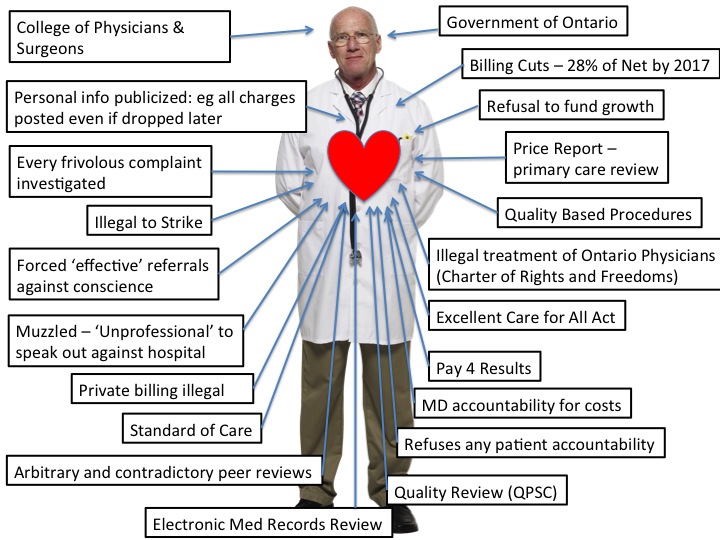
Doctors Under Siege

Slide1


This picture stands in place of several thousand words. It lists a small platter of the things thrown at doctors recently.

But the picture is too small.

We could add hundreds of pieces of legislation, dozens of statutes and regulations; special interest groups, competing stakeholders trying to smother any status doctors ever had; the media’s attack on physicians driving public envy-cum-schadenfreude.  It would fill a large mural.

We need to communicate the same thing five times to get across one message. But some things are heard only by those who want to hear them.

High profile politicians inside Premier Wynne’s cabinet demonstrate they do not understand what’s happening in Ontario when they speak privately. If members of parliament struggle to understand the issues, how can we expect voters to see through?

Ontario has put doctors under siege. A siege delivers victory by attrition or assault.  Getting the Ontario Liberals to negotiate with doctors would be a tiny step towards peace. But healthcare needs more; probably more than any political party can ever deliver.


[This post came from a local doc. He drew a sketch, took a photo and said, “Write the post!” Thanks, Scotty.]

Central Planning – Triumph or Fiasco?

hammock-beachAn acquaintance planned a spontaneous Caribbean getaway for his wife. He researched and booked a great resort. He got a super deal on flights. He informed his wife’s employer and secretly booked time off. He thought of everything, even a limo ride to the airport that evening.

His wife melted, how thoughtful!

Then she asked, “So who’s watching the kids?”

With only hours before their flight, they made frantic calls. Friends and coworkers ended up baby-sitting for a few days until the grandparents arrived on a last minute flight.

Planning – How Much is Enough?

Almost everything needs some planning. Even students back-packing Europe on Mom and Dad’s credit card still have to plan. Planning is good. But more of a good thing is not always better.

Leaders tread the line between thoughtful planning and micromanagement every day. They adjust their tactics based on results (past), or based on the nature of the situation they face (future). We can do the same with healthcare.

Central Planning in Healthcare

1. Results – How have we done?

  • Commonwealth fund study 2014 ranks Canada 10th out of 11 countries overall.
  • Patients wait up to 3 times longer in Canada.
  • Unemployed specialists look for work, while patient suffer long waits for the same specialty.
  • Overcrowded Emergency Departments remain the biggest problem facing emergency care.

Also, the Ontario government has supported naturopathy as mainstream care, has the world’s largest debt of any sub-sovereign government and has been plagued by political scandals.

2. Future – What can we expect?

Politicians should ask themselves: do they have the tools necessary to lead healthcare?

  • Can they lead managerial performance?
  • Can government influence attitude and initiative; if so, by how much?
  • What kind of workforce will a government service develop?

The “… public sector, by providing secure if unexciting jobs, can attract people who are relatively rigid and risk averse.” p 219 of Getting Health Reform Right A Guide to Improving Performance and Equity.

Seniority and patronage creep into every hospital. They occupy the space left by quantitative drivers of performance that dominate a typical business. We have a generation of managers who like seniority and patronage and have been attracted into management because of it. Not all managers. Many hold their noses and carry on. But on balance, patronage and seniority shape culture.

Government cannot control managerial level performance. It cannot control attitude, initiative or drive. How could it? It has no real levers to influence at that level.

The fact that the ministry of health wants to manage everything becomes the most important influence on managerial behaviour. It makes managers beholden to the ministry of health. It makes managers care about who controls the flow of money to their department instead of caring about patients who need service.

Government produces great crowds of administrators whose main objective is to stay out of trouble and not anger the ministry. Patient service need not improve above mediocrity; it’s a non-issue.

Policy vs. Implementation

Government needs to distinguish between policy and implementation. Over the past 35 years, government has usurped control over healthcare. Government no longer just pays for healthcare, it attempts to plan and run it.  It develops policies and tries to implement them but does not have the basic tools to do so.

Canadian healthcare performance lags. Even armed with the best solutions, government fails on implementation. We need to hold politicians to account and insist that they stick with politics and leave implementation to the professionals.

We need government to give medical professionals the freedom to innovate, lead and creatively solve practical problems for the patients they serve every day. We need a little less faith in central planning.

photo credit: viceroyhotelsandresorts.com