
Are Healthcare Economists Healthcare Experts?

mula-toy-hammering-block__0252853_PE399518_S4Healthcare economists see numbers and money not patients and care.

Professional economists study markets and policy.  They do not lead businesses, serve customers or develop product.  Sure, some CEOs take economics in undergrad but need MBAs and experience before leading big companies.

Take Michael Decter for example.  He’s a Harvard trained economist, previous Deputy Minister of Health and seems to be kind and sincere.  If you ever hear him talk about healthcare, ask yourself, “Who does he think leads and understands healthcare?” (see ‘Does Money Buy Change‘).

Decter wrote a piece recently called Saving Medicare. He talks about using paramedics, community nurses, pharmacists and palliative care to save Medicare.

He interprets symptoms of Medicare malaise, pronounces a diagnosis and prescribes treatment.

A Panacea

To a child with a hammer everything’s a nail.

Economists whack at provincial spending and fiscal policy.  And so they should.

But like chubby toddlers with hammers, they look around for other things to hit.  They pummel clinics and hospitals.  They batter doctor patient relationships redefining them as costs and waste.  They wrap pudgy fingers about their favourite hammers and reshape access to care and who provides it.  Then the government, like a good parent, lines up new shiny targets for economists to attack: utilization rates, collective bargaining, policy reform…

Experts at What?

  • Do economists run businesses?
  • Do they lead hospitals?
  • Do they build clinics or care for patients?

Then why do economists talk like experts on healthcare?

Economists rule in publicly funded medicine.  They’ve mutated medical care into discussions about money, legislation, policy and politics.

Economists train to observe and critique.  They expertly identify patterns and problems.  Even if we grant (generously) that economists correctly diagnose healthcare problems, that does not mean economists can accurately prescribe treatment.  Furthermore, there is no proof economists could operationalize their solutions without command-and-control legislation.

Top Down

Economists think high level and see patients as numbers, care as cost.  They generalize and offer idealized solutions necessarily top-down.  They invert healthcare.  Instead of starting with a patient and her doctor, Medicare economists start with governments and tax dollars.

They should use their expert skills to measure, model and predict.  Then they should be quiet.

Why, for heaven’s sake, do governments think they can run a $50 billion industry with leadership made of mostly economists, researchers and policy experts?

Medicine Redefined

Pundits see medical care as economic transactions instead relationships based on one party devoting themselves to meeting another’s need.  Politicians cannot imagine patients being cared for by anyone other than purely self-interested providers.  Bureaucrats cannot understand therapeutic relationships.

Doctors and patients need to take back medicine.   It requires continual effort to keep healthcare about patients and providers instead of policies and budgets.  On behalf of patients everywhere, physicians need to challenge economists’ diagnoses and treatments.  We need to challenge economists’ definition of healthcare.  Healthcare is about therapeutic relationships not anonymous economic policy.

Healthcare economists are not healthcare experts.  What do you think?

Photo credit: Ikea.com
Provider Guilt and Healthcare Waste

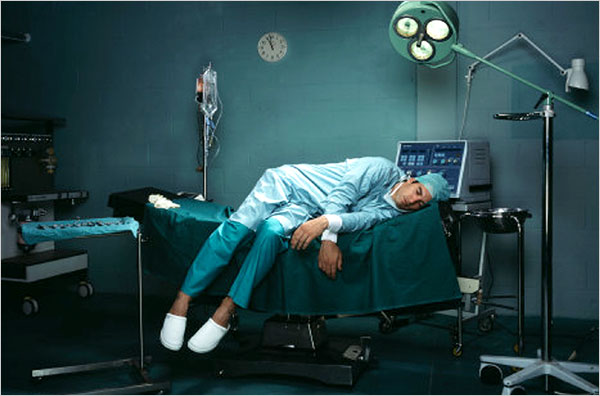
doc asleep“But your patients expect to see you,” she said.  “It doesn’t matter if it’s 8 o-clock at night… When I need my doctor, I expect him to answer.”

My mother’s words still echo 25 years later.  She nursed 2 floors of Alzheimer’s patients by herself. She’s practical and tough with medical concerns.  She managed most things without any support, largely alone, at night, with very sick patients.

When she finally calls a doc, she expects an answer.

Physicians used to be available 24-7.  They slept in hospitals as much as home.  It grew out of guilt, duty, greed, social expectations, escape from personal relationships…a complicated list.

24-7 created some odd physicians.

People now realize that healthy providers give better care.  Patients benefit with doctors fully engaged, fully aware.

Guilt

“There’s a patient who needs…[some great need]…up near [some place 40 minutes away].”

The one, lost sheep…

Often lost sheep have many people who could help and might even do a better job of helping.  But physicians feel a ‘proper’ doctor would go and attend.

Driving 30-40 minutes, one way, to see one healthy patient while making 8-10 other patients wait or rebook appointments is not model behavior.  It is not altruistic.  It is profligate, wasteful.

Healthcare Waste

Payers and auditors obsess over unnecessary tests and visits.  They care less about efficient use of physician time.

Patients benefit when physicians spend time with them.

No matter what else planners dream up, the system should always maximize physician efficiency to keep maximum time available for patients.  Regulations, bureaucracy, forms, record keeping for 3rd parties, audits, and quality improvement projects must be measured by the time they steal from patients with their doctors.

Guilt & Waste

Provider guilt works like another layer of wasteful bureaucracy.  It often makes physicians steal time from dozens of patients by pretending to model sacrificial behavior for one.  Guilt often blends with pride; providers like people to know about our sacrifice and hardships.  Often our stories of sacrifice are examples of time stolen from other patients who needed us more.

Efficiency is…

Everything we do means something else cannot be done.  Thankfully, patients now expect their physicians to maintain their personal and family life.

We need the system – and all the providers in it – to insist physicians stay maximally efficient.  Before all else, healthcare efficiency should start with measuring how much time physicians could be spending with patients if they didn’t waste it somewhere else.

Photo credit: nytimes.com

Healthcare Appetite – Curbing Demand

increased-appetite-400We talk about patient choice.  We applaud patient-centric care.  Our society values autonomy above all other virtues.  But we squirm when we talk about healthcare appetite and curbing demand.

Should we curb our appetite for healthcare?

Can we curb appetite?

Are we fine curbing others’ appetites, just not our own?

People want more.

  • More food.
  • More clothes.
  • More stuff.
  • And more healthcare.

Free-Marketists say the invisible hand of the market will limit appetite.  Supply and demand naturally curb consumption.  But what about consumption based on need, not just want?

Medicare fundamentalists ration appetite with wait lists, regulations and bureaucracy. Red tape strangles appetite before it grows beyond the public purse regardless of torture-by-wait-list.

In the West, we believe more is better.  We do not espouse enough.  We do not believe in moderation.  We imbibe, work and play to the limit and sometimes beyond.  Restraint, discipline, delayed gratification and self-control belong to an old-fashioned ethic.

“Use it up. Wear it out. Make do or do without.”

Restraint made sense in wartime; everyone rationed to protect property and country. But not now.

Medicare dawned on the ashes of World War II. Citizens knew rationing.  They remembered wheat rations and ‘patriotic foods‘.  25% of Canadians were rural in the 1960s, with less convenient access to healthcare.  Today, most Canadians live in cities with better access to modern (expensive) care. (see Statscan here and here).

As 1940s parsimony becomes ancient history, we can expect appetite for healthcare to get bigger.  Our system has “no brakes“.

Healthcare Appetite and Patient Choice

Patients need an incentive to consume less, or payers will ration care.  Incentives imply choice.  Choice implies patient control.  Control must include responsibility for costs , or costs will sky-rocket.

Medicare fundamentalists believe patients are too stupid to be given control over anything, especially their health.

Some Medicare zealots realize that eliminating choice and rationing care smacks of totalitarianism.  In response, they promote soft paternalism or libertarian paternalism. They believe we should create a society that makes it easy for people to make wise choices.  Master planners should make it very hard for common people to choose what utopian designers have decided are bad choices.

Most of us find unrestrained appetite repulsive in others but invisible personally.  Are we mature enough to discuss appetite and restraint or will we leave it to the state to define limits for everything?

“The more corrupt the state, the more numerous the laws.”  – Cornelius Tacitus

We need to discuss our opinions about choice, appetites and limits.  If we do not, choice will be removed by the state.  Power will be given to (or taken by) a few who place arbitrary limits on everyone.  Is that the kind of society we want?

 (Photo credit: health.com)