 Before armies figured out how to kill each other with explosives, they built castles.
A tiny army could lean from the tops of their stone fortress and taunt their enemy. Powerful armies stood helpless before much weaker forces.
Castles led to standoffs, and standoffs turned into siege warfare [historical paraphrase]. Armies found it more efficient to starve an enemy through siege than to attack a fortress head on.
Terms of surrender rejected by those inside the castle, at the start of a siege, might look very attractive after months of uncertainty. Resolve often ran out long before rations.
Strong positions held at the beginning of a siege become idealistic wishes at the end. Desperate people accept almost any terms of surrender.
Doctors Under Siege
Doctors in Ontario have been under siege by the government of Ontario since 2012.
Between 2012 and 2014, a momentary truce saw doctors agree to future cuts in return for reversal of some of the unilateral cuts Minister Deb Matthews hurled in 2012.
Doctors purchased peace by accepting the 5% (FIVE percent) cut from unilateral action, plus a negotiated 0.5% (zero point five %) annual cut going forward.
The government attacked again in 2015. After a full year of “negotiations” where the government just kept repeating “no more money”, the government launched unilateral action for the second time in 2 years.
It cut 2.65% (retroactively applied to 2014 fees). And government also cut 2.65% to 2015 and 2016 fees. These cuts added on top of the 0.5% fealty that started in 2012 and has not stopped.
Unbelievably, in October 2015, the government lobbed yet another attack by clawing back 1.3%.
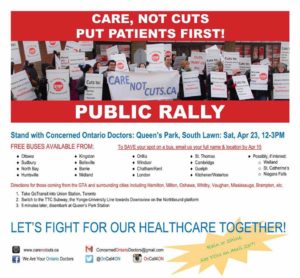
This final claw back birthed a spontaneous activist group of 11,000 members on Facebook, the Concerned Ontario Doctors.
They have a massive rally planned, with patients and allied supporters, at Queen’s Park this Saturday (see poster below):
Will Doctors Surrender?
The siege leaves physicians with a 30% cut to net earnings, by 2017 (cuts + inflation + overhead increase).
Many doctors are desperate. They cannot run businesses with so much uncertainty. They cannot buy equipment, renovate offices, or hire staff without knowing whether the government will loot more of their fees.
Doctors have plenty of rations for a prolonged fight with government. But a siege uses psychology to attack resolve.
Desperation drowns idealism. Many physicians face tough questions from bankers. Loans risk recall, especially for those early in practice.
After 5 years of destroyed relationship with government, and the second full year of all-out siege warfare, doctors are tired. They want to get on with their lives.
Government knows this.
Eventually, the government will offer terms of surrender. Don’t be surprised if doctors cheer and jump at any offer, just to get out of the siege.
If it happens like the battles in the 1990s, doctors will accept the current evisceration of the physician services budget as a trade for peace and certainty.
It will leave doctors with another 15 years to climb back up to where they were in 2012, when fees had finally caught up to inflation from the 1970s.
Hopefully, the 1990s taught doctors to not accept peace for its own sake. Rebuilding medical services must start as soon as talks re-open, not 10 years later, like it did in the early 2000s with primary care reform.
With the aging tsunami closing in, doctors need to hang on to their idealism and not sell out for peace. How much will doctors surrender to end the siege?
 .
.