Doctors Vilified in Medicare History

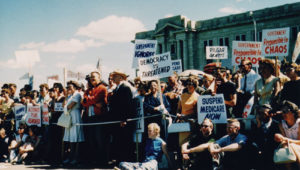
Protesting Medicare 1962Great tales start with, Once upon a time…

Academics tell the story of Medicare like this:

Once upon a time, in the dark days before universal healthcare, patients lay at home suffering in pain. Wealthy patients went to shining hospitals with all the modern specialists they needed.

Everyone else traded potatoes and chickens for medicine offered by the rare doctor who would stoop to see them.

Patients died in pain. Or they sold their farms to pay for treatment, declared bankruptcy, and then died in pain from curable diseases.

In these dark days of pre-civilized Canada, one person started to campaign for the poor and oppressed. From the wilderness of Saskatchewan, someone finally stood up for patients.

When no one else cared, Tommy Douglas, champion of the poor and oppressed, dared to challenge the medical establishment. Mr. Douglas single-handedly attacked organized medicine.

He shamed doctors’ selfishness.

He demanded Canadians do what was right: provide free care for all, without consideration for patients’ ability to pay.

Mr. Douglas demanded that doctors put aside their greed for the sake of their patients. He forced doctors to put patients before income.

Doctors fought back. They went to war with Tommy Douglas and refused to see patients.

After a 23-day strike, doctors surrendered. They lost the war and submitted to Douglas’ plan of care for all, not just the rich and well connected.

Tommy Douglas gave Canadians Medicare.

Finally, no one would ever lose their farm to pay for medical bills. Now, people could take out business loans and invest in the economy. Mr. Douglas civilized medical care in Canada.

It was the dawn of a new age.

Doctors Vilified (Again)

But just when people started to celebrate, the doctors took a dying stab at Douglas’ dream. Doctors said they would agree to Medicare only if they could work ‘fee for service’ (FFS).

FFS was the condition of their truce.

Mr. Douglas desperately wanted to help the poor. So he compromised at the last minute. He gave doctors what they wanted: to be paid for each service they provided.

Poor Tommy did not know what he allowed. He let the fee-for-service virus infect Medicare.

Evil Fee for Service

Fee for service (FFS) paid doctors for services they performed. FFS drove doctors to invent procedures and to dream up new services to provide patients, whether patients needed them or not.

FFS drove up the cost of care.

It created run-away spending.

Doctors, ravenous for more and more income, worked and worked and worked. They toiled around the clock just to make more money, to bill more services.

Patients have suffered ever since.

Finally, the government said, Enough! FFS must go. We will put doctors on capitation.

And the golden age of primary care reform began. Now doctors work in teams, where patients get only as much care as they need.

And everyone lived happily ever after.

Reality

Theatrics aside, most people see doctors and government as reluctant partners for the last 40 years in Canada.

Every schoolboy knows that doctors have caused the situation we now find ourselves in: provinces unable to pay for care, and patients dying on wait lists.

In reality, before Tommy Douglas rescued Canada from doctors, there were insurance companies that covered the costs of acute care. Patients who could not afford to pay the premiums had the premiums covered by the government (see Setting the Record Straight: A Doctor’s Memoir Of The 1962 Medicare Crisis).

The few people who refused insurance, and still could not afford care, saw doctors for free. Doctors believed their professional duty demanded that they treat people who could not pay. Either way, patients had coverage, if they wanted it.

Governments could choose to cover the insurance premiums for the poor. The option existed. If government did not, it was not for lack of ability to do so.

Greed vs. Freedom

Doctors’ incomes were not at stake in the strike in 1962. Doctors actually enjoyed a huge boost in pay under Medicare.

Finally, all their bills were paid. They could stop charity work and spend more time on things that paid.

Purely selfish motives should have led doctors to support Medicare from the start.

But they did not.

Tommy Douglas campaigned on a government takeover of healthcare. Doctors resisted government takeover on the belief that government cannot care for patients. Many doctors had fled the UK after seeing what government does, when they take command and control a whole industry.

Politicians, who control healthcare, end up treating it as a bauble to win support. They throw handouts to win votes; care to win elections.

Governments meddle and ration.

Politicians fund popular procedures, like sex reassignment surgery, and leave patients who need less popular treatment, like cancer care, to die on wait lists.

Politics

Tommy Douglas wanted to nationalize an industry because it fit with his political convictions.

He believed government could do a better job than anything designed by the citizens themselves. He believed a group of highly trained, super-smart elites, who worked for government, could serve patients better than a patchwork of doctors in communities across Canada.

Douglas passionately believed in the state – the government – as the most trusted force for good in society. He saw bureaucrats and politicians disinterestedly working for the ‘public good’ as the best way to provide care.

He fundamentally disagreed with Adam Smith, in The Wealth of Nations: businessmen do not try to serve their customers; they try to exploit customers at every turn.

Wringing Our Hands Over Access

Today, we hear about desperate attempts for patients to see doctors on evenings and weekends.

Why won’t doctors see patients outside of office hours?

How selfish and insensitive!

No one in academia dares to tell the truth about this. Research grants and university tenure depend on government support for their institution.

The truth is this:

Government fixes the price for services as low as possible. It pays $33 for diagnosing pneumonia during the daytime, and a couple dollars more to see the same patient in the evening.

After paying a pittance for evening work, government castigates physicians for not providing access to patients in the evenings and on weekends.

Academics never mention this. They just wring their hands about how doctors do not seem to care about seeing patients after hours.

Doctors would LOVE to see their patients in the evenings! But billings must cover the cost of hiring staff willing to work after hours, or doctors work for free.

Government knows that if they pay an appropriate premium for doctors to work after-hours, and on weekends, like patients want, then doctors will provide ALL their services after-hours.

Doctors want to provide services that patients need, in a way that patients want them delivered. 

But costs go up when doctors work to serve patients. Utilization, the amount of medical services delivered, increases.

So instead, government rations care by refusing to cover the cost of after-hours care and blames doctors for the lack of access.

Doctors Need to Speak Up

In a time of universal deceit, telling the truth is a revolutionary act.

G. Orwell

Doctors need to speak truth to power. They need to write, speak, publish, and do whatever they can to peacefully protest. Patients need to know.

Government has failed to deliver on its promise to provide care.

Canadians are under-insured.

Government took over a whole industry and then blames underperformance on doctors. Enough is enough.

When will people stop telling fairytales to feed political agendas?

Photo Credit: Encylopedia of Saskatchewan
Why I Believe in the OMA and You Should Too

Ontario-Medical-Association-1We all have something in our family that we never mention. Every family has skeletons. Yet, we work to promote our best family face.

We talk about our children’s accomplishments and awards. We want people to know the best about who we are. We cringe if someone asks about our struggles.

“All happy families are alike; each unhappy family is unhappy in its own way.”

― Leo Tolstoy, Anna Karenina.

Every doctor in Ontario has a family name. Our family name is the OMA. The Ontario Medical Association is only as smart and witty and compassionate as those of us who get involved.

If doctors want the OMA to look or behave differently, then doctors have to help to make that change.

It’s Your Family

If we hate how our family behaves, or what people think of our family, we work to change the impression. We spend time improving behaviour and reputation. We work with other people in our family to make things better. We never publicly criticize our family.

But that does not mean we fawn and gush over our family, either.

We courageously admit when things are hard. We accept when our family stumbles and disappoints, or even embarrasses us. But we never disown our family. We own our family’s failure just as we own its success.

Believe in the OMA

Doctors have tremendous power, tremendous opportunity, with the OMA. It is our organization, our family. Any doctor can stand for election and get ‘inside’ the political structure. Anyone can influence change from within.

The OMA stands unique in that it unites doctors around the one thing that doctors hold in common: caring for patients.

The founders of the OMA gave power to working doctors. They invested authority in a group of 250 working doctors at council. Council members direct the board to do the daily work of the OMA. They hold the board to account. If the board disappoints members, then members vote them out.

Over the years, many groups have tried to improve the OMA from the outside. The Coalition of Family Practice campaigned against the OMA in the 1990s. Eventually, they infiltrated and got 8 members elected to the board.

They overhauled how the OMA looked and behaved in the early days of primary care reform.

Today we have new groups: Ontario Doctors for Justice, Concerned Ontario Doctors, and others. These groups inject passion into the OMA.

They serve a valuable purpose. Members from grassroots organization run for office and transfuse enthusiasm and energy in a crisis. They work to renew and transform our organization.

Flawed, Like All of Us

The OMA is like any other human invention: flawed. But it is the best that doctors have. The OMA offers the best opportunity to create change in Ontario. It provides the most organized, funded, and powerful voice in medical politics.

If you want to be at the centre of medical politics, you MUST get involved in the OMA. There isn’t any better way.

A Personal Note

I started at OMA council because I was mad. I thought,

How dare they force me to pay dues! They do not care about my life, my work.

I got involved because I wanted change.

So I attended my first council meeting. I met scary smart people who had spent their lives – literally 30 years – trying to improve our healthcare system. They had made dents here and there, but they had not seen the transformation they hoped for. Still, they refused to give up. I realized that change in medical politics is hard, impossibly difficult

Years later, I still want change.

If readers look through the comments on this blog, they will find many times when doctors attack the OMA. Many of my posts invite those attacks. I want people to say what they think. I want to wrestle with the issues beyond slogans and hyperbole.

I believe in the OMA enough to want to make it better. I work passionately to improve the OMA. I do not pretend it is perfect. I do not cover its faults. But I never stop believing that it is the very best way to drive change in healthcare.

When people care about something, they work to improve it. They do not ignore its failures, or pretend they do not exist.

If you take the time, you will find that every time someone attacks the OMA, I defend it. I admit where we could have done better. I share the struggles at the time. I invite ways to improve.

But I always defend our organization. I stand by the OMA.

I will quit, if I stop believing that.

After years of service, and countless hours of unpaid advocacy, I still believe the OMA offers Ontario’s doctors the best vehicle for change.

If doctors do not like what the OMA is doing, then they need to get involved and change it.

If doctors get involved, they see how the OMA’s job is almost impossible. Doctors who get involved see how hard it is to change things in Ontario. They get a peak at all the work that no one sees on the outside, which no one can talk about publicly.

I believe healthcare in Ontario needs major change. And I believe the Ontario Medical Association is the best vehicle to make it happen.

If you want to see change in Ontario healthcare, then you need to be involved in the OMA. Stand for election. Get inside. Help out. It’s your family name.


The End of Doctor Protests

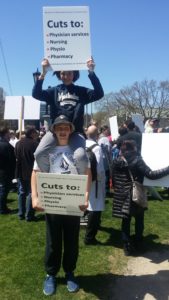
20160423_125107 (1)There is a first time for everything. Doctors, patients, and concerned citizens have never marched together in protest over cuts to healthcare in Ontario.

For the first time, doctorsled by the Concerned Ontario Doctors group, marched in Toronto to protest cuts, on April 23, 2016.

They did not just gather on the lawn at Queen’s Park, like in 1986. They marched through the streets under police escort.

A careful head-count at the rally spotted over 1000 people. The parade stretched around a full city block. Drivers honked and waved in support.

Patients, members of provincial parliament, and organizers spoke before a row of media in front of the legislature. The crowd held a minute of silence. Speakers shamed hospital cuts and patient waits.

“If liberty means anything at all, it means the right to tell people what they don’t want to hear.”

George Orwell,  Animal Farm

The End of Doctor Protests

Since 2012, communications experts have told doctors to speak up: get on social media, write to local newspapers, and meet with members of parliament.

The end of doctor protests was to raise awareness, to apply pressure to politicians. The means were writing and speaking.

Just never hold a public gathering, the experts said.

Every time anyone asked about a rally, some older physician – a wizened expert on medical politics – would tell stories about doctors jumping barriers the last time they gathered at Queen’s Park in 1986.

It sent chills through us all.

God help us! Someone might misbehave in public.

Provincial governments across Canada keep watch on Ontario. If Ontario gets away with unilateral actions against doctors – legislating without discussion – then other provinces mimic the tactic to save money.

Nova Scotia just overturned their laws on binding arbitration. Quebec legislated the number of patients doctors must have in their practices.

Define or Be Defined

Post modern society judges a cause by the amount of outrage it creates. No outrage? Your cause must be lame.

Calm, principled intransigence comes across as unfeeling condescension in the face of real injustice.

Public Attack

When someone attacks you publicly, time stops. We ask ourselves, “Did that just happen? Did they just say what I think they said?

The audience looks to us in disbelief. They withhold judgment waiting for our response.

If we quibble and stutter some inane argument, we lose. The audience, as jury, decides the attack is legitimate. We lose the battle of public opinion, even if we have the best argument.

Peace trumps war most of the time. But there comes a point when calm, reasoned responses work against us. There is a time to fight.

At least once – even just for one tiny moment – we need to speak up with passion. We might just get a tiny bit angry, if only for a few seconds. Our response to outrageous attack defines us.

“In the animal kingdom, the rule is, eat or be eaten; in the human kingdom, define or be defined.”

Thomas Szasz

The End of Protest

In The End of Protest: A New Playbook for Revolution, Micah White, founder of the Occupy Wall Street movement, describes why public protest no longer changes society. It does not work. The Occupy movement tried to change too much. It asked for something that no one could deliver.

Doctors ask for something that government can deliver. Doctors ask to stop cuts to healthcare. They ask for binding arbitration, as suggested in the Canada Health Act.

After 4 years of cuts to medical spending and 9 years of sub-inflationary spending on hospitals in Ontario, government must fulfill its promise to provide healthcare, or give the responsibility to someone else.

The end of protest is change.

Doctors need to protest more, not less. The public gauges the merit of an issue by the degree of outrage.

Doctors act like a Baptist pastor at a barn dance. They avoid the event, or stand stiffly in a corner in case any dancing breaks out.

Cuts harm patients. If doctors believe that, they will gird their loins and speak up. The end of protest is change. The time is now. Can doctors show some emotion for their cause?

In a time of universal deceit – telling the truth is a revolutionary act.”

George Orwell