Doctors Must Compete or Be Replaced

arm-wrestlingBroken bones mend inside rigid casts.  But immobilization causes muscles to shrink and deform, sometimes permanently.

Rigidity and over-protection harms everything: children, plants, muscles and even doctors. Grinding through patients in an artificial monopoly, with never any thought to competition, erodes patient service.

Doctors Must Compete

Nurses give Botox. Naturopaths do blood work. Chiropractors manage musculoskeletal problems.

Pharmacists are becoming clinicians, too. They offer cardiovascular risk assessment, osteoporosis and melanoma screening, flu shots, smoking cessation, home visits and a menu of public health services.

The roster of ‘providers’ grows every year:

  • chiropodists
  • physiotherapists
  • occupational therapists
  • massage therapists
  • social workers
  • psychologists
  • midwives
  • nurse practitioners
  • respiratory techs
  • surgical assistants
  • nurse endoscopists
  • nurse anesthetists
  • even paramedics treat minor issues.

Government expands the list of things everyone else can do but seeks to limit doctors’ scope of practice. Government supports other providers assuming medical care but limits doctors’ competitive advantage.

Dentists, lawyers and veterinarians hire assistants to leverage their expertise. Doctors can hire assistants but not to see more patients. Government only pays for patients seen by doctors. Every other professional can expand the services they offer – XRays, stat blood work, biopsies, U/S – except doctors.

Service Erodes

Doctors used to sit at the top of a very short list of providers. Patients needed doctors’ services. So government took over medicine and set fixed prices. But the monopoly undermines doctors’ ability to innovate. Aside from specialized medical care, many patients now find services from allied providers more attractive than what doctors offer.

Rigid pricing, regulation and legislation make it almost impossible for doctors to innovate around patients’ needs or interests. Non-procedural docs are losing market share but cannot change their business model to compete.

Competition improves service and efficiency. Patients get better service when their doctors have to compete to provide care, but regulation almost eliminates it.

Protectionism

In fairness, most doctors do not want to compete. It’s nice owning a piece of shoreline on the only beach in town. Until everyone gives up swimming.

Ironically, doctors need to fight against the monopoly that lets them float through their professional careers without ever worrying about competition, market share or margins.

Politicians cannot touch Medicare, so they undermine it, while doctors rearrange deck chairs.

If doctors truly care about medicine, truly believe that it’s the best for patients, they need to work to dismantle the monopoly. Allow other providers, colleges, regulatory bodies and payment schemes. Open it up. Let it breath.

Protectionist structures suck the vigour out of patient service. It atrophies wrapped inside over-regulation and legislation.

Disruptive Innovation

University-owned mainframe computer services once felt secure in their monopoly. They knew that no one could provide what they had to sell. They knew that puny personal computers could never compete on service or performance. (Article: What is Disruptive Innovation?)

That’s still true. Mainframes do offer space age computing. It’s just that people realized they could get along fine without mainframes.

If doctors do not fight back soon, patients will realize they can get along just fine without most doctors, too.

photo credit: newsfeed.time.com

What is Government Good At?

canadian-flag-640Remembrance Day summons powerful images. Sacrifice for a greater good; submission for country and neighbours; conviction that we can fight evil and win.

Governments earned public trust between 1939-45. Even though they were tiny by today’s measure, governments ran a near impossible war effort. We won, and our government enjoyed two decades of unchallenged support.

If government can coordinate a whole country to win a war, surely it can do other good things? Small, empowered bureaucracies proved they could move raw materials, have industry make combat boots and parachutes, and send thousands into battle.

Nothing establishes credibility like success. Victory crushed any debate about whether government could act as a force for good with civilian problems. Armed with public support, governments set to work on popular social issues.

More work required a bigger crew, and government mushroomed to the task. No one thought to ask whether we had won the war because government was small, not in spite of it.

Devotion is often blind. Once lost, it requires another war to regain. Government waste, scandals and personal failures have obliterated public trust today.

In recent focus groups with baby boomers, a large public affairs firm found people expected government bungling. Boomers got angry about many things, but shrugged with familiarity at government scandals.

What is Government Good At?

D Savoie, from the University of Moncton, reminds us that public servants used to work for the public good in What Is Government Good At?: A Canadian Answer. [Credit Savoie for the next few paragraphs.] Public servants served ends that markets could not in areas where markets could not reach.

The public service was supposed to be best at “equality, efficiency, merit, fairness and justice.” This remained unquestioned, until government got big.

Government has tried to do more and more and now struggles in multiple sectors to implement anything. It tries to balance stakeholders and ends up disappointing.

Modern public service manages instead of setting policy. Margaret Thatcher started a trend to reshape bureaucracy. She wanted efficiency and accountability but forgot that bureaucrats do not have levers to move performance. The public service wants to look and sound like the private sector, but it cannot drive change.

The public sector has no bottom line, no market to generate revenues, no one to report to, and public servants never lose their job unless they embarrass their superiors.

Since the 1980s, government has been trying to invent a bottom line and somehow create market forces within the public sector. This has caused a shift to performance-based accountability, new oversight bodies and new program evaluation efforts. It has made bureaucracy today far more top heavy.

Most public servants now work in the central office as opposed to regional offices delivering services to citizens.  Bureaucracy slowly sinks under bloated reporting burdens.

Accountability and transparency make the public sector keenly attuned to blame. Blame get shifted to the top, to those with increased authority. Senior public servants spend most of their time managing political issues, public impression and voter support.

Those with little power or ambition get assigned to implementation. The New Public Management, or Managerialism, creates change masquerading as improvement (Rod Rhodes).

All this happens while media and parliament hold people accountable “as they see fit and on their own terms.”

Government should prove what it’s good at and get out of the rest.

Government Cannot Implement

It can measure, reward and punish, but government needs doctors to implement its fancy designs. That’s why bureaucracy will always resent doctors. It can turn nursing into a technical profession where nurses are judged by whether they ticked all the boxes on their 6 pages of progress notes. But government cannot understand why it fails with medicine.

The last 3 years of cuts have forced a generation of doctors to consider the limitations of government. Normally apolitical physicians must now consider politics as a force impacting patients’ health. And doctors are not impressed.

For the first time since the start of Medicare, many doctors have started to imagine healthcare under an Australian or European system. It reminds some people about the birth of Medicare, something we all hoped to forget.


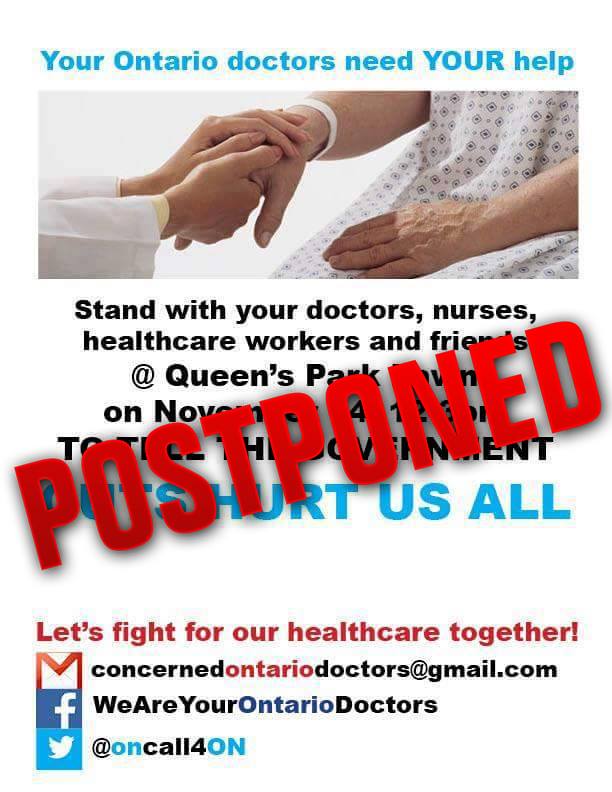
Queen’s Park Rally – Postponed

postponedAddendum: In light of the terror attacks in Paris last night, apparently the organizers have decided that the rally will join with the vigil at Nathan Phillips Square. Those who still show up will meet at Queen’s Park until 1330 then walk down to the Square. Aside from the pictures, the post below remains unchanged from the original. I add this just in case readers were attending based on this post.

I talked with a doctor this week. She works hard, spends way too long with patients and supports a large family.

I can’t do it anymore. It’s just not working out. My billings are already down 30%. I wish I could get out, find something else. Anything!

I heard from another doc. His RRSPs won’t support a lower middle class retirement. He cannot work harder. His accountant expressed concerns. But this doc is spent. He once had fire. Now he’s exhausted, demoralized.

Of course, some doctors feel almost no financial pain from Premier Wynne’s cuts. These rare docs earn a tonne, have a low overhead and live well within their ample means. But they’re angry too. Cuts make it harder to get patients needed care. Cuts make a difficult job almost impossible.

Doctors want action. Many feel desperate. Even if they find success with the Charter Challenge, what can they do now? And next year?

Queen’s Park Rally

A large group of grassroots physicians and concerned citizens have pooled their energy.  They organized a rally to start at 12 noon tomorrow, in front of the Ontario Parliament at Queen’s Park. They did this with no outside funding or help. It is not a strike, just a peaceful event to raise awareness. Doctors cannot strike.


postponedPay attention to the media this weekend but don’t hold your breath. Given cozy ties between the Liberal party and the CBC, we cannot expect positive coverage from them, if any at all.

Some outlets will take this rally at face value and report facts: Premier Wynne cut spending on medical services and now docs find it really hard to provide care. Clinics have closed (infographic). Docs have retired. New graduates plan to leave or have left already.

Many doctors tell me they need to take action and do something. Anything. Apparently, a huge crowd of doctors and concerned citizens will show up at Queen’s Park tomorrow. If nothing else, it will probably make them feel better. And who knows, maybe government will realize people have had enough?