
Medicine is Relationship, Not Quality Metrics

Kate and Emma in poolRelationships change us. Like walking in rain, we cannot be untouched in relationship.

Doctors make a living building doctor-patient relationships. Sure, we manage cardiac risks, renal function and multiple comorbidities. But more than these, our care starts and ends with relationship.

Dr. Michel Accad, a cardiologist, wrote a brilliant piece: The Doctor-Patient Relationship and the Outcomes Movement. He quotes an article, Strong Patient-Provider Relationships Drive Healthier Outcomes:

With over 50% of primary care providers believing that efforts to measure quality-related outcomes actually make quality worse, it seems there may be something missing from the equation.

I tweeted Dr. Accad’s post as it sped around social media. That afternoon, Dr. Debra Boyce shared a response she got from an “exceptionally smart family doc – very hardworking but rarely rants about anything”, Dr. Michelle Vilcini:

I love this!  I have thought for years that governments are missing the boat on what quality in health care truly is – measuring the wrong things, and trying to measure things that can’t be measured.

Our role as physicians is not only to “prevent hospitalization”   “cost less”  “reach diabetic and BP targets” and “have fewer C-sections” but to guide, empower, and support through friendship our patients who are struggling, who are vulnerable, who need a mentor who understands their health issues and their psyche and will be there for them, even if the outcome isn’t going to be good –the crusty old obese diabetic who smokes, drinks, lives in poverty, has no education, and was abused as a child, is not going to have a great outcome. 

But if I establish a relationship, an encouraging friendship, and he comes to see me every 3 months, shares a joke, reveals pieces of his childhood, cries for the first time in decades when sharing a tidbit of his past, he feels cared for (when no one else cares for him).  Not helpless. 

So when he doesn’t lose weight, doesn’t stop smoking, doesn’t improve his A1c, and then has another heart attack, does that mean I have failed? In the end, our family practice patients all die (so by definition they have a bad outcome).  On paper, I haven’t done a good job.    

But if the patient or the family has felt comforted, supported, and understands better their illness and the consequences by having me walk with them as they are experiencing their bad outcome, I have succeeded.  I don’t really care about anything else.

She went on:

I do truly believe that a caring family doc provides better holistic care to my (actually real) patient than sending him to multiple silo chronic disease management clinics…diabetic clinic, renal insufficiency clinic, CHF clinic, smoking cessation clinic…. he can’t afford the parking and none of those clinics address the guy as a fallible human being who isn’t really interested in meeting their targets and getting put on Ezetrol and Lantus and whatever else.  He only wants to see me because I am a friendly face….

Does this mean doctors can do whatever they want with no accountability to measurable outcomes?

It might appear that way. But we know that patients without any primary care have worse outcomes overall. Patients with chronic disease, who try to manage with episodic visits to clinics and emergency departments, create medical nightmares.

Medicine is Relationship

Having a relationship with a doctor improves health. If that is true, we should not have to prove it again with lab values.

Redefining medicine as a technological intervention undermines care. It changes the essence of medicine – its ontology – from a doctor-patient relationship into applied technology. And it ignores the physician-end of the relationship (see Dr. Bernadette Keefe’s excellent articleQuadruple Aim – Care of the Physician).

The burden of proof should rest on government to show that patients would be better off without doctors than for doctors to prove their worth by how well they adjust lab values.

Doctors are competitive. As they bear increased scrutiny for performance against physiologic outcomes, more doctors will slavishly aim for better lab values. They will improve their metrics. But will patients benefit in the process? Or will we just improve a bunch of numbers?

The doctor-patient relationship serves as the basis for all medical intervention. Relationship is the only therapeutic manouver in many cases. Without it, treatment fails. Perhaps we need greater protection and support for relationships than accountability to lab values and ‘quality-related outcomes’?

 

Sue Government, Then What?

Blind JusticeWise people insist that patience is a virtue. No question, absence makes us fonder for some things. But waiting ranks between nuisance and torture most of the time.

Just wait ’til your father gets home!

Someone’s here from a lawyer’s office. I’ll let her in.

Thanks for calling back. Just wait while I get the doctor.

The minutes between hearing – and our new life that follows – linger long after the news. Waiting separates our old self; it opens an existential gap filled with uncertainty.

Sue Government

Doctors launched a challenge under the Canadian Charter of Rights and Freedoms against the Government of Ontario this week. It argues that government ignored doctors’ rights. It will take years to settle. This is the second time doctors have had to sue government in 3 years.

In the meantime, we wait. We wait while politicians hack away at medical services, and access deteriorates.

What if doctors lose their case? Maybe the courts will find in favour of the government?

Perhaps a judge will award an arbitration process, but arbitrators might find that there is absolutely no way to return services back to 2012.

Maybe an arbitrator will reset the game, call a start-over with all the players in their current positions. An arbitrator might say that physicians in the new grad entry program should be grateful with their $100k salary. It was their choice to study medicine. They could have become nurse practitioners, if they wanted.

What happens between suit and settlement?

New grads leave, as they should. Established doctors who can relocate take their chances while there’s still work elsewhere. Retirement beckons others. Meanwhile, government can go on to cut more. No one can stop it.

Government will probably make an offer to settle the suit. Will doctors blink and drop it?

If the government offered a 2% raise with stability for 4 or even six years, would doctors make a deal? Would they give up their basic rights for a bowl of porridge?

Strategic Pause

All professional athletes have talent; the greatest know when to not use it. A simple pause can work better than a trick shot. But an expected pause does nothing. The game goes on with no change in strategy.

Doctors hope the Charter challenge will bring fundamental change in how government deals with physicians. It calls for new rules, an acknowledgement that doctors have the right to be treated fairly, too.

Lawsuits change people. The wait after filing solidifies new character.  Two lawsuits in three years has shown a whole generation of doctors the worst of central planning, of nationalized public service. Very few docs enthuse about working with government these days. It helps younger doctors understand the suspicion older colleagues have long held about government programs.

Doctors have placed their faith in a justice system built on rights and freedoms. Let’s hope it’s worth the wait.


How to Influence a Board

the imperfect board memberI got into trouble for doing what I thought was a good thing. I wrote a letter to the paper.

I challenged the Minister of Health to come down to our hospital, Hospital X, and see for himself patients languishing in hallways, ambulances backed up.

I dared him.

The board Chair blew up. The CEO, the Chief of Staff, the President and the Vice-President of the Medical Staff Association delivered angry lectures.

My department Chief scolded me. I felt really stupid.

Worthy motives cannot ignore politics. Truth needs a proper package to drive influence. When a wall blocks our path to freedom, truth told for its own sake can make the wall collapse on top of us instead of opening to freedom.

What do Boards do?

Boards govern organizations. They do not manage them, staff do. Boards meet a few times per year, or as often as once per month.

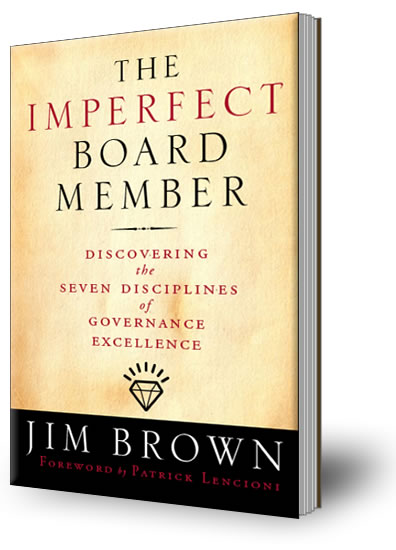
Jim Brown lays out core functions for board directors in his little book, The Imperfect Board Member: Discovering the Seven Disciplines of Governance Excellence (read it!).

Here are a few of the facets and responsibilities of a board of directors:

Reflect – Understand and think about the results of the organization’s operations and the rationale for deviations from projections.

Respect – Listen. Listen to understand the members; invite input from members; help members understand board actions and organizational results.

Select, Redirect, Eject – choose people with the skills, values and credibility to fulfill key responsibilities; remove them if they compromise the organization’s effectiveness.

Direct, Protect – define and refine the vision, mission and values; determine key results areas; create and use a monitoring system.

Expect, Inspect, Correct – Articulate board expectations of the organization and CEO and maintain them. Understand and comply with expectations within the board and contribute to an effective team.

How to Influence a Board

Ideally, all board directors put themselves in your shoes. They show deep understanding and compassion, like your Grandma. But even Grandma loses compassion, if you pick a fight.

Do you want influence? Address what matters to others.

Positive influence drives controlled change towards a known target. Attack creates reaction, unknown and uncontrolled. Try to repackage your issue into a board issue. For example:

  • Talk about how your issue represents a larger problem.
  • Demonstrate that you understand the challenges the board faces.
  • Find something, anything, positive to say.
  • Offer help.
  • Suggest a solution.
  • Gracefully answer questions, even when questions prove your audience doesn’t ‘get it’.
  • Speak for a group. Numbers matter.

Write Smart Letters

What emails do you read right away? What gets deleted before opening?

We cannot resist emails addressed to us, from people we know, about issues with personal meaning. If you want to make a big impact, you need relationship.

Focus attention on one or two people. Use the list above. Add value. Make them want to open your emails. Then hit them with what you want changed. Remember, long lists of complaints sent to a big group are a waste of time. They get deleted.

Trouble

Churchill said, “You have enemies? Good. That means you’ve stood up for something, sometime in your life.”

No matter how polished your politic, you will irritate. But if you influence well, you can get in trouble for doing good things and not feel stupid about it.