
Non-Clinical Careers Conference – Review

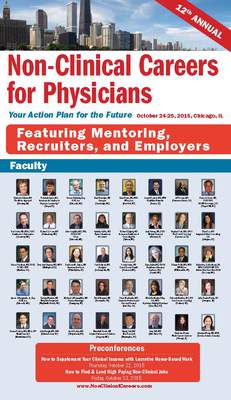
SEAKOver 400 physicians met in Chicago for the Non-Clinical Careers for Physicians Conference this weekend. We learned about dozens of jobs outside clinical care.

Many of you asked for more details. So I pulled most of the following information from the organizers.

I enjoyed it and would try to attend the pre-conference symposia next time.

Jobs at this conference included:

  • Large International Pharmaceutical Company – Associate Medical Directors working in Pharmacology, Clinical Development, Medical Affairs, and Drug Safety (3 Full Time Positions)
  • National Health Insurer– (16 Full time positions available including one work from home position)
  • Niche Consulting Firm– Physician engineers (10 Full Time positions)
  • Top National Insurance Company(1 Full time position)
  • Top Research Based Biopharmaceutical Company( 1 Full time Position related to drug safety)
  • National Medical Necessity Company(3 Full time positions)
  • National Consulting Company(Many contractors needed to perform IMEs and Fitness for Duty Exams)
  • National Peer Review Company(Looking to add 150-200 independent contract physicians to its roster each month)
  • Physician Disability Consultants(Home based independent contractors)
  • Workers’ Compensation Utilization Review Company(Up to 100 remote independent contractors wanted)

Non-Clinical Careers Conference

After cornerstone lectures with the whole group on the first morning, 35-40 recruiters, mentors and coaches each introduced themselves from a packed podium. We stampeded after them to book appointments over the next two days.

Then we picked lectures that ran concurrently over the remaining day and a half. Check out the main link for the schedule.

We learned about many of the following jobs, including training, time required, pros, cons and remuneration:

  1. Academia/Teaching
  2. Administration
  3. Author
  4. Blogger
  5. Business Owner
  6. Clinical Research/Development
  7. Coaching
  8. Communications Specialist
  9. Compliance
  10. Consulting Firms
  11. Contract Research Organizations (CROs)
  12. Disability Consultant
  13. Drug Safety/Pharmacovigilance
  14. Education
  15. Entrepreneur/Business owner
  16. Expert Witness/Litigation Support
  17. Federal Government
  18. Financial Planner
  19. Healthcare Advocate
  20. Health Guidance Organization Medical Director
  21. Health Insurance
  22. Hospice Medical Director
  23. Grant Reviewer
  24. Informatics/Heath Care Information Technology
  25. Insurance Free Medical Practice
  26. Journalist/TV Reporter
  27. Leadership Development
  28. Life Insurance
  29. Market Medical Director
  30. Medical Communications
  31. Marketing Consultant
  32. Medical Device Company Medical Director/Consultant
  33. Medical Director
  34. Medical Ethics
  35. Medical Marketing
  36. Medical Science Liaison
  37. Non-Profits
  38. Peer Reviewer
  39. Pharma (Industry)
  40. Physician Advisor
  41. Physician Executive
  42. Physician Training
  43. Portfolio Career
  44. Provider Network Medical Director
  45. Public Health
  46. Regulatory Affairs (Pharma)
  47. Software Developer
  48. Solo Consulting
  49. Speaking
  50. Staff Physician
  51. Utilization Reviewer
  52. Wellness
  53. Writing (Freelance)

Lectures on career cycles and change resonated with the audience (MD career cycles). But as mentioned above, >75% of the conference focused on physicians in different industries.

Some participants complained. They seemed to expect a job fair. But most people said they never expected so many doctors and so many jobs. I got what a hoped for, a scan of non-clinical careers.

Let’s hope government pays attention before too many doctors discover opportunities outside Medicare.


Doctors’ Response to Cuts – Get a New Job?

dr philPhilip McGraw built a career by asking, “How’s that working for you?” He learned early that no matter how hard you try, only outcomes matter.

You can’t eat intentions, only results.

I suppose that’s how I came up with one of my favorite questions: “How’s that working for you?” When I ask that, I genuinely mean it. How is what you’re doing working for you? Are you getting what you really want and need?

Dr. Phil might ask doctors, How’s this working for you?

Did you ever imagine spending your spare time fighting government?

Doctors’ Response to Cuts

Doctors at the lowest end of the fee scale and those with the biggest cuts react first. They are marginal customers, those most sensitive to changes in quality or price.

Initially doctors just grumble, work more and adjust their services. As cuts deepen, doctors lash out. After years of repeated cuts, blame and slander, doctors give up. They reach a point of readiness for substantial change.

Grumble and Shift

Doctors cope by working longer and harder. It’s their first response.

Then, they adjust their clinical time. Doctors start to:

  • Offer shorter visits.
  • Consider fewer problems per appointment.
  • Down size their practice.
  • Move into cosmetics.
  • Take more time off.
  • Close satellite clinics.
  • Spend more time operating on WSIB patients
  • Expand time with military clinical services
  • Retire

These are not threats. They are facts.

Speak Out

After 2 1/2 years of cuts, grassroots doctors explore activism.  Small coalitions of frustration pop up. A group of Ontario MDs formed on FaceBook with over 11,000 members. They met with MPPs, media and mobilized to Queen’s Park. They got heard.

Seek Substantial Change

But activism without outcome does not satisfy. Doctors diagnose and treat. They care by doing. Without tangible outcomes, doctors start to fidget. By nature and training doctors want to identify work accomplished.

Doctors have two options, change work or change the system.

Journalist Andre Picard wrote an article telling doctors to relax. Stop sounding so entitled. Empty threats of leaving sound pathetic. Government should just say, “There’s the door.”

Many have left. Young doctors plan to leave as soon as they can.  Two patients asked to join my practice last week; their doctor had gone back to Florida to escape Premier Wynne’s attack on doctors.

But even more doctors leave in a different way. They check out. They give up trying to change the system. They turn attention to work that offers tangible outcomes. A number of physician leaders in medical politics have said, “I’m done.” They already have jobs in related administration or some other area.

In many ways, this helps government.  Government would love novice or less passionate doctors to step up.

Doctors tell unbelievable stories.  They talk about horrible hours, disrespect and a grim future for medicine. At some point people start asking docs, “So, how’s that working for you?” What they really mean is, “Why don’t you change jobs?

Doctors are human.  They cannot perform when demoralized. We do not want doctors shifting their time away from patients or considering other careers. But it’s happening. As healthcare unravels, we might ask voters, “So how’s that working for you?

photo credit: pinterest.com

MD-Government Relations – A New Approach?

leafs1967We learn from our mistakes, at least some do. The Toronto Maple Leafs won their last cup in 1967.   Maybe the saying should be,

Some people learn from their mistakes, but most rarely take the opportunity.”

Ontario’s doctors see 2004 and 2008 as big wins. By 2012, docs had finally caught up to inflation after losing since 1986. While everyone takes credit for the victory, the feds probably deserve most valuable player. They shovelled billions as Canada Health Transfers starting in 2004 growing at 6% per year, $13 billion in fiscal year 2015-16.

It created a new economy in healthcare. Relationships and collaboration ruled the day. Cooperation reformed primary care for the first time since Confederation. Bureaucrats and physicians partied at the same events.

But every binge ends poorly. Liberal governments have a fierce and jealous love of debt. Ontario now has more of it than any sub-sovereign borrower in the world.

MD-Government Relations

The economy collapsed in 2008, the biggest slump since 1930. It happened just after Ontario signed a 4 year deal with doctors. The government was too weak to renege, even though it tried in 2011. So government took revenge in 2012 and has abused doctors ever since. It looks like the fights of 1970-2003.

Doctors need to refocus, start over with reaffirmed thinking.

New Perspective

  • Do we want a physician services agreement or the freedom for physicians to serve?
  • Should doctors focus on special programs or basic principles?
  • Do doctors value partnership with government more than self respect?
  • Are some things more important than getting ‘stability’ or a small raise?

New Process

  • Are we best served by a small group of physicians negotiating on our behalf?
  • Do we need a Buzz Hargrove to guide us?
  • Do we need new blood with innovative thinking?
  • How should our structure change to deliver different results?

New Presuppositions

  • Do we believe government bureaucracy can ever manage healthcare?
  • Is more government better?
  • Are doctors the cause of all, or most of, the problems in healthcare, or are they the solution?
  • Does the Canada Health Act give government the right to usurp control of healthcare?
  • Should public administration refer only to the collection and distribution of taxes?
  • Should the government provide oversight or micro management?

Fail Fast

A great leader said recently, “Fail fast.” Pay attention to performance and abandon losing strategies. Failure is inevitable. Repeating failure is not.

Doctors fought hard in the 60s and 70s. But after a few years of Medicare, doctors could not deny that universal everything is a really nice way to practice.

Until the money runs out. And be sure of this, doctors will get blamed as services and access decline.

Will doctors try to mend relationships and recreate the glow from ’04 and ’08, more of the same? Will we become the Toronto Maple Leafs of medicine?

photo credit: thestar.com