
Doctors’ Action Plan

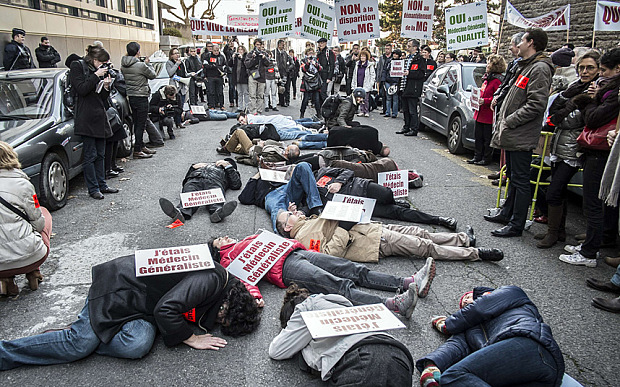
french-doctors-in-streetsDoctors want blood. They got hit again, and no one seems to care.

The Liberals cut 4.45% this year already, with more to come. But patients have not seen a change in service.

Patients will feel the rigid cap on spending in 3-4 years, long after Premier Wynne leaves for a new social agenda.

Doctors want action, now.

Doctors’ Action Plan

Many doctors ask, What can I do?

Buried in dozens of emails, I try to share this general message:

  • Be bold.
  • Take action.
  • Accept risk.  
  • Build alliances. 
  • Inspire others.

Be Bold

Bold does not mean angry or stupid. Bold means not fearful or hesitant in the face of possible or actual danger.

Anger and stupidity blind us to danger. Boldness steps forward with eyes open. Doctors need to know what they are stepping into. Talk to others. Listen to stories about other fights with government. Know the danger. But do not hesitate.

Take Action

We are all different. Some people write. Others talk. Doctors need to find that kind of action most suited to their identity, their character.

Some doctors write research papers for fun. For them, writing a scathing academic analysis seems like a great ‘job action’.

We cannot expect all doctors to take the same action. It would feel odd. The first action should look different than the final action. Save some cards to play later.

Action does not mean harming patients or lying in the streets. Doctors cannot strike.

Accept Risk

Failure, even the thought of failure, immobilizes most doctors.

Activism does not come with a multiple choice test at the end. You cannot plan to get an A+.

You will stumble. You will make mistakes, offend others by accident and generally cause yourself pain.

There are no perfect messages or perfect ways to attract attention. Just get as much advice as you can, then be bold and take action.

Build Alliances

We achieve more together. Political parties, rock bands, churches and social movements rarely survive as one group. They divide and sub-divide.

We do not need to agree on everything. Alliances topple regimes. We need a strong alliance (union?) to fight tyranny.

Inspire Others

Pick 1 or 2 things that really bug you. Double-check your facts. Second guess your motives. Then make your simple message public.

People love authenticity; they cannot look away.

Use your message to inspire others. Don’t bother inspiring people you do not like. Inspire those close to you, people you’d want to see anyways.


Doctors are angry. Now we need to focus. Re-check our vision. Look for advice and partnerships. Then act boldly knowing that we will not be perfect.

No one can tell you what one thing you must do. The OMA can hire lawyers and expert media firms. They need our support, but real change comes as we convince one person at a time.

We can start with those closest to us.

Do you want your care capped?

Do you support a rigid limit on how much medical care patients get?

If not, why not help us pressure the Liberals to negotiate with Ontario’s doctors?

photo credit: telegraph.co.uk
 

Doctors and Democracy – Fight for Your Rights

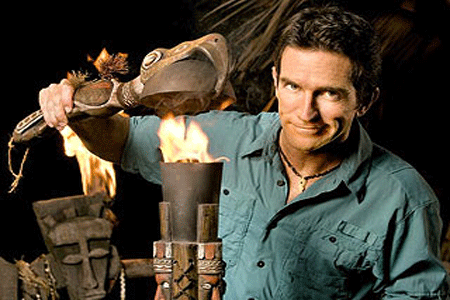
survivor-torchGetting voted off the island is like being thrown under the bus, except more people do it to you.

The reality show, Survivor, gave votes to players so that the majority could send losers off the island, out of the show. Everyone got a secret ballot in the war of all against all.

Survivor is democracy in action, right?

Doctors and Democracy

When everyone votes directly on issues, we call it direct democracy. When we elect representatives – who are supposed to represent us, not their party – we call it representative democracy.

Voters send representatives to parliament to speak for all of us, doctors included. Politicians speak for everyone in their riding, not just the mob that funded their election campaign. Politicians are supposed to have ideas of their own and not just parrot their party leaders.

We elect politicians to speak for doctors and protect them like every other minority group in society.

Democratic Despotism

Over 150 years ago, Alex d’Tocqueville warned about democratic despotism. He described a kind of despotism that grew from a too fervent or uncritical devotion to the sovereignty of the people. Despotism arises when the majority democratically blesses a despot in trampling on the rights of others. (What Tocqueville foretold: a despotic democracy.)

Democracy fails when politicians ignore the rights and freedoms of minority groups.

Rights, Duties and Handouts

Do rights mean handouts, freebies? Do doctors have rights?

Everyone demands his right to publicly funded services. Most of the time, rights are just another way to take something that is not yours without calling it stealing.

Rights relate to our understanding of liberty. In his famous essay on liberty, Isaiah Berlin said that positive liberty assumes someone else provides for it. Positive rights (liberty) put duties on someone else to meet the demands of the rights in question.

If you demand the right to education or healthcare, then the government has the duty to pay for it.  (People used to talk about education and healthcare as privileges of citizenship.)

Positive rights demand handouts.

When doctors complain about government trampling their rights, they do not mean positive rights.

Berlin described a more basic kind of right: the right to be left alone, to not be attacked or have your property stolen.  Negative rights (liberty) let you form free associations and act according to your conscience. They include the right to live free of tyranny and oppression; the right to pursue and practice a career in the way you see best.

Negative rights demand the right to be left alone.

Mobs, Doctors and Democracy

The founders of Western democracy feared mobs like the Jacobins in the French Revolution. Advanced societies speak for minorities the mob would otherwise devour.

This means protecting the rights of the weak. But it also means protecting the rights of special people who develop rare genius, like Steve Jobs or Bill Gates. If we allowed mob rule, Jobs and Gates would have had their successes stolen by the majority, long before we got to enjoy their inventions.

Western democracies were designed to protect the rights and freedoms of all from the tyranny of the majority, and the state.

Doctors – Time to Fight?

Doctors have been voted off the island. They’ve been thrown under the bus while other groups get contracts –  teachers, nurses and police.

No one else gets cuts, four years in a row. Doctors are ignored by politicians and most of the media.

Is it right that:

  • It is illegal to practice medicine outside of the provincial insurance plan?
  • The Province of Ontario cut MD fees in 2012, 2013, 2014 and 2015?
  • Premier Wynne will claw back fees doctors billed for seeing patients who needed care?
  • Ontario blocked new doctors from practicing in the team models they were trained in, and expected to fill?
    • New docs were sent back to fee for service (FFS). Team care is to FFS as Tim Horton’s is to a private doughnut shop.
  • The CPSO demands ‘effective referrals’ even if doctors believe it will not benefit their patient? The CPSO can take away their license for refusing.
  • The CPSO restricts doctors’ right of association?
    • They demand MDs start doctor-patient relationships with all patients who walk through the door – if patients fall within the scope of a doctor’s training – even if doctors do not believe they will be able to meet patients’ demands and expectations.

Failed Democracy

Modern society requires you to fight for your rights. Doctors cannot depend on elected representatives. MPs do not know the issues and cannot (or do not want to) understand them. Medicare has grown up and changed.

Doctors, democracy has failed you. Stop expecting patients to care about fee cuts. Stand up and fight. Write letters. Challenge government usurpation of care. Prepare to fight. A lawsuit will not save you. Claw-backs are looming on top of the >25% loss in your net income since 2012.

If you plan to keep practicing in Ontario, all doctors will have to fight for their rights: to care for patients, to fair treatment by government, to free association and to free enterprise.  What are you prepared to do?


Healthcare Iron Cage

Sign Sign Everywhere a Sign

“There are these two young fish swimming along and they happen to meet an older fish swimming the other way, who nods at them and says “Morning, boys. How’s the water?

And the two young fish swim on for a bit, and then eventually one of them looks over at the other and goes “What is water?

— David Foster Wallace, This is Water

Max Weber showed us the water. He said that the most rational way to organize human activity, maximize efficiency and eliminate favouritism was with hierarchical bureaucracy.

The father of sociology, Weber gave us Weberian Civil Service. Weber’s bureaucracy controls medicine, education, all branches of government and most large corporations today.

But Mr. Weber was curiously honest about his bureaucracy. He did not disguise its ugly side.

He predicted it would put an “iron cage” on each of us and, eventually, a “polar night of icy darkness.” Max Weber blamed capitalism for pulling us into bureaucracy. He said it created institutions that limit choice in favour of a “technological utopia”.

Healthcare Iron Cage

The Iron Cage is a “technically ordered, rigid, dehumanized society”, a set of rules for all of us.

A Bureaucracy:

  • Concentrates power in a few people that are generally unregulated. (oligarchies)
  • Breeds on the fixed belief in its superiority. Spawns more bureaucratization and rationalization.
  • Turns individuals into cogs in a machine. People focus their careers on becoming bigger cogs.
  • Sees people as units of labour to be bought by the bureaucracy. Others dictate the price of your individual services; the value of your accomplishments.

Weber explained that bureaucracy arises from rational design. He believed it was an inescapable fact of reason. But rational bureaucracy produces irrational results.

Health bureaucracies exist to provide care for the sick but limit access to medical services. National health insurance (Medicare) guaranteed doctors payment for all services, but put doctors out of work by closing operating rooms and blocking them from joining practices. Each industry could add its own stories as the same irrationality happens in agriculture, forestry and education.

No one knows who will live in this cage (Gehäuse) in the future, or whether at the end of this tremendous development entirely new prophets will arise, or there will be a great rebirth of old ideas and ideals, or, if neither, mechanized petrification, embellished with a sort of convulsive self-importance. For the “last man” (letzten Menschen) of this cultural development, it might well be truly said: “Specialist without spirit, sensualist without heart; this nullity imagines that it has attained a level of humanity (Menschentums) never before achieved.

Protestant Ethic: [Weber 1904–05/1992, 182: translation altered].

No one talks seriously about bureaucracy anymore, except maybe the anarchists. David Graeber, famous for ‘We are the 99%’ from the Occupy movement, has a new book, The Utopia of Rules: On Technology, Stupidity, and the Secret Joys of Bureaucracy. While I disagree with violent anarchists, I plan to read Graeber’s book.

Have we confused bureaucracy with government, the healthcare iron cage with medicine?

Giles Fraser wrote in the left-leaning Guardian, “…the left has assumed that defending (or being silent about) the smothering prevalence of bureaucracy is all about defending the state.”

Medical associations should challenge the healthcare iron cage. We could use the multi-million dollar medical bureaucracies to build ‘iron cage’ committees. Imagine our association bureaucracy fighting government bureaucracy, bureaucracies attacking bureaucracies.

Maybe that’s dreaming. Maybe the healthcare iron cage, too, must lead to a polar night of icy darkness as Weber predicted.

Photo credit: theunsecretshopper.com